Charge 5
Fitbit Charge 5
Previous generation with much the same form factor. Google sells bands for both Charge 6 and Charge 5, and DC Rainmaker confirms Charge 5 bands fit.
See band system
To install WriStreet on your iPhone, tap then “Add to Home Screen”.
Install WriStreet on your phone: it opens like an app, even offline.
Verification: Verified by the maker
Proprietary connector
Indicative information. Check your watch before buying a strap: wristreet.com is not responsible for an incorrect size.
Not sure this is your reference? It is engraved on the case back, or between the lugs at 6 o'clock.
Previous generation with much the same form factor. Google sells bands for both Charge 6 and Charge 5, and DC Rainmaker confirms Charge 5 bands fit.
See band systemAll 10 Fitbit Charge references and their strap sizes
Band sizes from the maker's own pages, case by case.
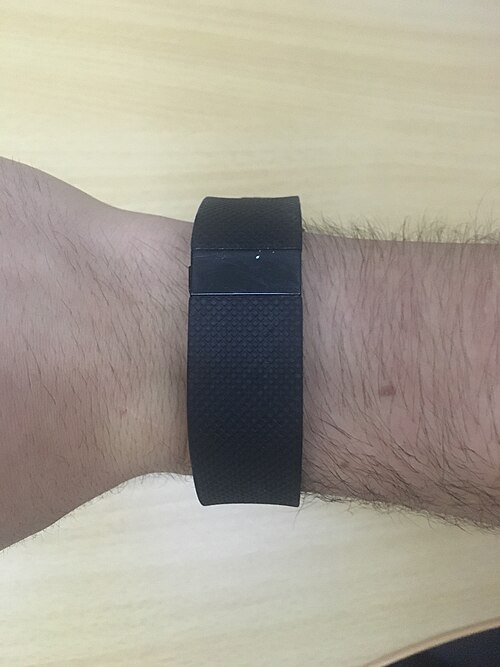
Own a Fitbit Charge? Add your photo.Share a photo
The Fitbit Charge 6 takes Fitbit Charge bands, which work with the Charge 6 and Charge 5.
Proprietary connector.
Charge accessory bands work with Charge 6 and Charge 5
Google sells its bands under the name Fitbit Charge 6 & Charge 5, so the same bands are offered for both trackers.
Both sizes come in the box. The small fits wrists 5.1 to 6.7 inches around and the large fits 6.7 to 8.3 inches.
The included band is a flexible, lightweight silicone strap with a loop and peg closure.
Google says the tracker is water resistant to 50 m but not waterproof, and the rating fades over time. It also warns that some Charge 6 bands are not water resistant, so check the band before swimming.
Google lists Infinity Bands, Sport Bands, Vegan Leather Bands, Premium Horween Leather Bands and an Adjustable Stretch Band.
It measures 36.73 mm long, 23.09 mm wide and 11.20 mm high, and weighs 30 g.
The story · Since 2014
The Charge arrived the year Fitbit recalled its previous band, the Force, after 9,900 reports of skin irritation. Its heart-rate sibling, the Charge HR, was the best-selling fitness tracker in the US from April to September 2015.
79%
share of Fitbit revenue from the Charge, Charge HR and Surge in Q3 2015
Worn by
The first Charge counted steps, floors and sleep and showed caller ID from a nearby phone. In early 2015 Fitbit added the Charge HR at $149.95, reading heart rate from the wrist at the cost of two days of battery. By the third quarter of 2015, the Charge, Charge HR and Surge together brought in 79% of Fitbit's revenue.
Fitbit's Charge HR was the first of its trackers to bring continuous, automatic heart rate to the wrist, the company said in 2016. It used a watch-style buckle, which PCMag notes the Charge 2 kept.
The Charge 2, announced on 29 August 2016, kept the heart-rate sensor and gave the tracker a display that Fitbit said was four times larger than the Charge HR's. Unlike the original Charge, it offered interchangeable bands, so the same tracker could change look for different occasions.
The Charge 2 reached stores worldwide on 26 September 2016 at $149.95, built to succeed what Fitbit called its best-selling wristband. It estimated cardio fitness from VO2 max, guided two or five minute breathing sessions and let owners swap bands and clock faces. It ranked number one on Amazon.com in fitness and heart rate monitor categories.
Announced in August 2018, the Charge 3 traded stainless steel for aluminium, about 20% lighter, and gained a touchscreen 40% larger than before. It was waterproof enough to track pool swims. Its SpO2 sensor was non-functional at launch, and Fitbit gave no timeline for enabling it.
The Charge 3 in 2018 was the first wearable with an inductive button, which let Fitbit make the tracker swimproof. Fitbit described its touchscreen OLED as nearly 40 percent larger and brighter than its predecessor's. The Charge 4 in 2020 added built-in GPS, Spotify controls and the Active Zone Minutes metric.
The Charge 4 arrived on 15 April 2020 at the same $149.95 and finally carried its own GPS, so runners could leave the phone at home. It introduced Active Zone Minutes, a heart-rate goal of 150 minutes a week, along with Fitbit Pay and Spotify controls.
The Charge 5 launched in September 2021 at $179.95 with a colour AMOLED screen and no physical button. Its small colour screen and seven-day battery carried over unchanged to the next generation, which shows how settled the formula had become.
The Charge 5 in August 2021 moved to a colour AMOLED display, Fitbit's first tracker with an always-on option, and Fitbit said it was ten percent thinner than its predecessor. The Charge 6 in September 2023 claimed up to 60 percent better heart-rate accuracy during vigorous activity, added a haptic side button and brought Google Maps and Wallet to the wrist.
The Charge 6, open for pre-order from 28 September 2023, brought back a haptic button and added Google Maps and Google Wallet, plus heart rate streaming to Peloton and NordicTrack machines. When Google ended Fitbit smartwatches in 2024, the Charge was one of three Fitbit ranges it kept. In October 2026 its successor, long rumoured as the Charge 7, arrived under a new name: Fitbit Edge.
Photographed from 2020 to 2022 with a rose gold Fitbit Charge on a grey band, including at the Commonwealth Day service in Westminster Abbey in March 2022. Hello! and Fit&Well identified it as a Charge 3 from photos.
While rebuilding his fitness in 2021, the actor used a Charge 4 to track calories, exercise and steps, before Fitbit signed him to lead workouts on its Premium service.
The US marathoner, sponsored by Fitbit, wore a Charge 2 on her Women's Running cover in 2017 and called it her go-to tracker when not running for pace.
2026. In 2026 Google gave the successor to the Charge 6 a new name, the Fitbit Edge, with a Pixel Watch style body and a 1.34-inch screen.
2026. With the Fitbit Edge launch on 12 October 2026, Google said it was discontinuing the Charge line, leaving the 2023 Charge 6 as its last model.
2024. After a firmware update released on 21 December 2023, more than 100 Charge 5 owners reported batteries draining in hours or dead trackers; it echoed a wave of complaints in July 2023. Google told the BBC the update was not the cause.
2023. The Charge 6 could stream its heart rate to Peloton bikes, NordicTrack machines and Tonal, and Fitbit claimed its sensor was 60% more accurate than the Charge 5's.
2016. At the Charge 2 launch, IDC counted Fitbit as holder of more than a quarter of the worldwide wearables market, with basic trackers growing nearly 49% in a year while smart wearables shrank.
2015. NPD Group ranked the Charge HR the best-selling fitness tracker in the US from April to September 2015, ahead of rivals including Garmin.
Credited with Jacqui Belleau, Susan McKinney and NewDealDesign LLC as designers of the Fitbit Charge HR (2014 to 2015) in the Chicago Athenaeum's Good Design 2015 listing.
Credited with Dan Clifton, Susan McKinney and NewDealDesign LLC as designers of the Fitbit Charge HR (2014 to 2015) in the Good Design 2015 listing.
Credited with Dan Clifton, Jacqui Belleau and NewDealDesign LLC as designers of the Fitbit Charge HR (2014 to 2015) in the Good Design 2015 listing.
Red Dot's Charge 5 project page names Mia Robertson in the 'In-house design' field.
(2022) listed in the Good Design Awards (The Chicago Athenaeum), Personal 2022. The Fitbit Charge 5 is in the Personal 2022 list. The organiser's entry describes a reinvented band attach system with four band styles: silicone, perforated sport, Velcro and leather.
The user experience of the Fitbit Charge 3, credited to Fitbit Design, won Good Design in the Personal 2019 category.
The Fitbit Charge HR (2014 to 2015) is listed among the products awarded Good Design 2015 in the Electronics section.
Announced September 28, 2023 with the Charge 5 form factor, a returning haptic button and a new heart rate sensor.
Uses the same band connector as the Charge 5, so Charge 5 bands are fully compatible.
Released in September 2021 with a 1.04 inch color display and built-in GPS.
Almost identical in design to the Charge 3, with a plastic resin case instead of aluminium.
Charge 3 bands fit the Charge 4.
A redesigned, swim-proof tracker with an inductive button instead of a physical one; introduced in October 2018.
Wareable says Charge 2 and Charge 3 bands are not interchangeable.
Bigger display and slimmer design, plus continuous heart rate carried over from the Charge HR.
First Charge with removable bands, released by squeezing two metal prongs under the band.
The first Charge band arrived about a year after the Flex, two years before the Charge 2.
Google said the Charge 6 was the first time it brought Google Maps and Google Wallet to a Fitbit tracker. It also brought Fitbit's first accessibility feature, Zoom + Magnification.
The Charge 6 can broadcast heart rate over Bluetooth to compatible gym equipment and apps.
The gap between the two lugs that hold the strap, in millimetres. A new strap must match it exactly: 20 mm lugs take a 20 mm strap.
Most watches use spring bars, so any strap of the right width fits. Many smartwatches use their own band system instead, such as Apple Watch bands or Garmin QuickFit.