40,000approximate number of original Emergency watches purchased
$7 millionspent on developing the first Emergency, over about 10 years
51 mmEmergency II case, up from 43 mm for the original
- 1985 to 1994
Every function through the crown
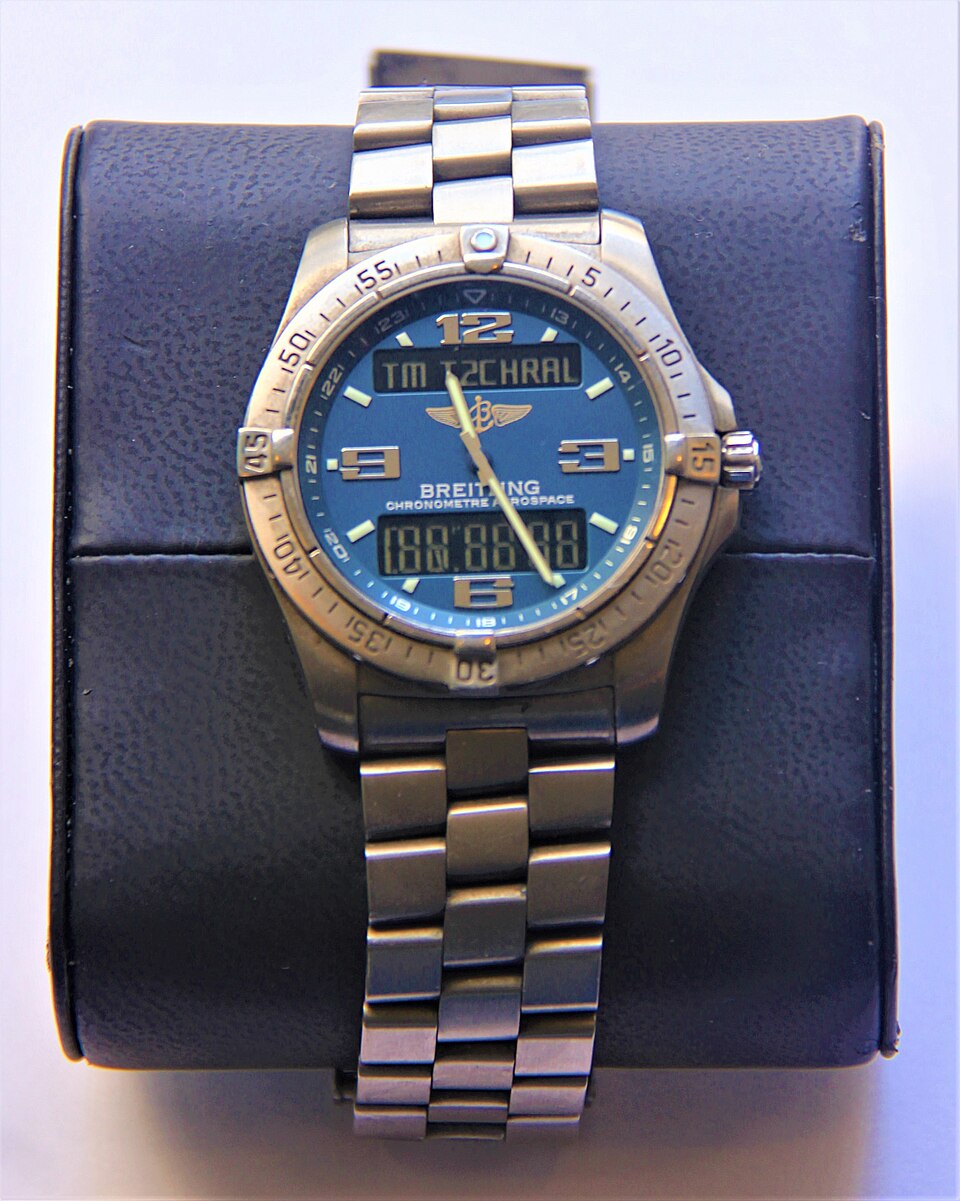
The Aerospace of 1985 combined analog hands with two LCD screens in a titanium case, and every function, from the 1/100 second chronograph to the alarm, ran from the crown. The first reference, 80360, measured 40 mm and still read Navitimer on the dial. In 1994 ref. 56062, known as the Aerospace II, enlarged the lower screen.
- 1995 to 2000
A watch that calls rescuers
In 1995 Breitling announced the Emergency, a 43 mm titanium watch with a transmitter on the 121.5 MHz air distress frequency, developed with Dassault Electronique. Development took nearly a decade and $7 million, and the watch could not be sold until Swiss regulators approved it in May 1996. US approval came in 2000.
- 2001 to 2012
Rescues on the record
The Aerospace moved to the SuperQuartz caliber 75 chronometer in 2001, then grew to 42 mm with a backlit caliber 79 as the Aerospace Avantage in 2005. Meanwhile Emergency owners kept activating their beacons: two British pilots after a helicopter crash near Antarctica in 2003, a stranded hunter in Alaska in 2012.
- 2013 to 2019
Two frequencies, one wrist
After Cospas-Sarsat stopped satellite monitoring of 121.5 MHz in 2009, Breitling spent five years on the Emergency II, shown at Baselworld 2013. It added the 406 MHz satellite frequency and a rechargeable battery, in a 51 mm titanium case. The same year the Aerospace Evo took the case to 43 mm.
✦2012. Alaskan hunter Mark Spencer, hypothermic after more than 48 hours alone, was found by helicopter after activating his Emergency; his separate beacon put him four miles off.
✦2003. Quentin Smith and Steve Brooks were found in a raft in the Drake Passage after activating an Emergency on 121.5 MHz; Smith said no one had survived a ditching there before.
✦1999. Breitling Orbiter 3 completed the first nonstop balloon flight around the world on 20 March 1999, its two pilots wearing Emergency watches. The capsule went to the Smithsonian's National Air and Space Museum in 2000.
✦1997. An Emergency saved the 13 crew of the Mata-Rangi, a reed boat blown off course by a storm after sailing from Easter Island toward Australia.
✦1995. In December 1995 the Emergency proved itself in a Hong Kong search-and-rescue exercise involving the RAF, the Royal Navy, the US Air Force, Navy and Coast Guard.